Brochure website
A brochure website is the online version of a well-made leaflet: who you are, what you do, where you work, what it costs and how to get in touch. For a cobbler, a mobile hairdresser, a dog groomer or a bookkeeper working from home, that is often all the website needs to be.
Free: a 30-minute call, an action plan and a price range in writing.
Five things
a small site
cannot skip
What you do, in one sentence
At the top of the page, in words a customer would use: not a slogan.
Where you work
Town, postcodes or a radius, and opening hours. People want to know you will come to them or that they can park nearby.
Prices or price ranges
Even rough figures beat "call for a quote". They filter out time-wasters and reassure serious customers.
Proof
Photos of your actual work and a link to your Google reviews.
One obvious way to contact you
A call button and a short form, or WhatsApp if that is how your customers prefer to talk.

Simple site,
simple process
Short call
Twenty to thirty minutes on what you do and who your customers are.
Copy
I write the text and send it for your approval.
Design
Phone and desktop layouts, three rounds of revisions.
Launch
On your domain, linked to your Google Business Profile, with basic tracking.
Brochure
website cost
Prices in pounds sterling, fixed in writing. Hosting and domain agreed individually and kept in your name.
Everything on a single scrolling page.
- From 10 days
- Copy written for you
- Call button and form
- Google Maps link
Home, services, about, prices, contact.
- Separate pages for main services
- Basic SEO set-up
- Simple edit areas
- 3 rounds of revisions
Who a brochure website is for
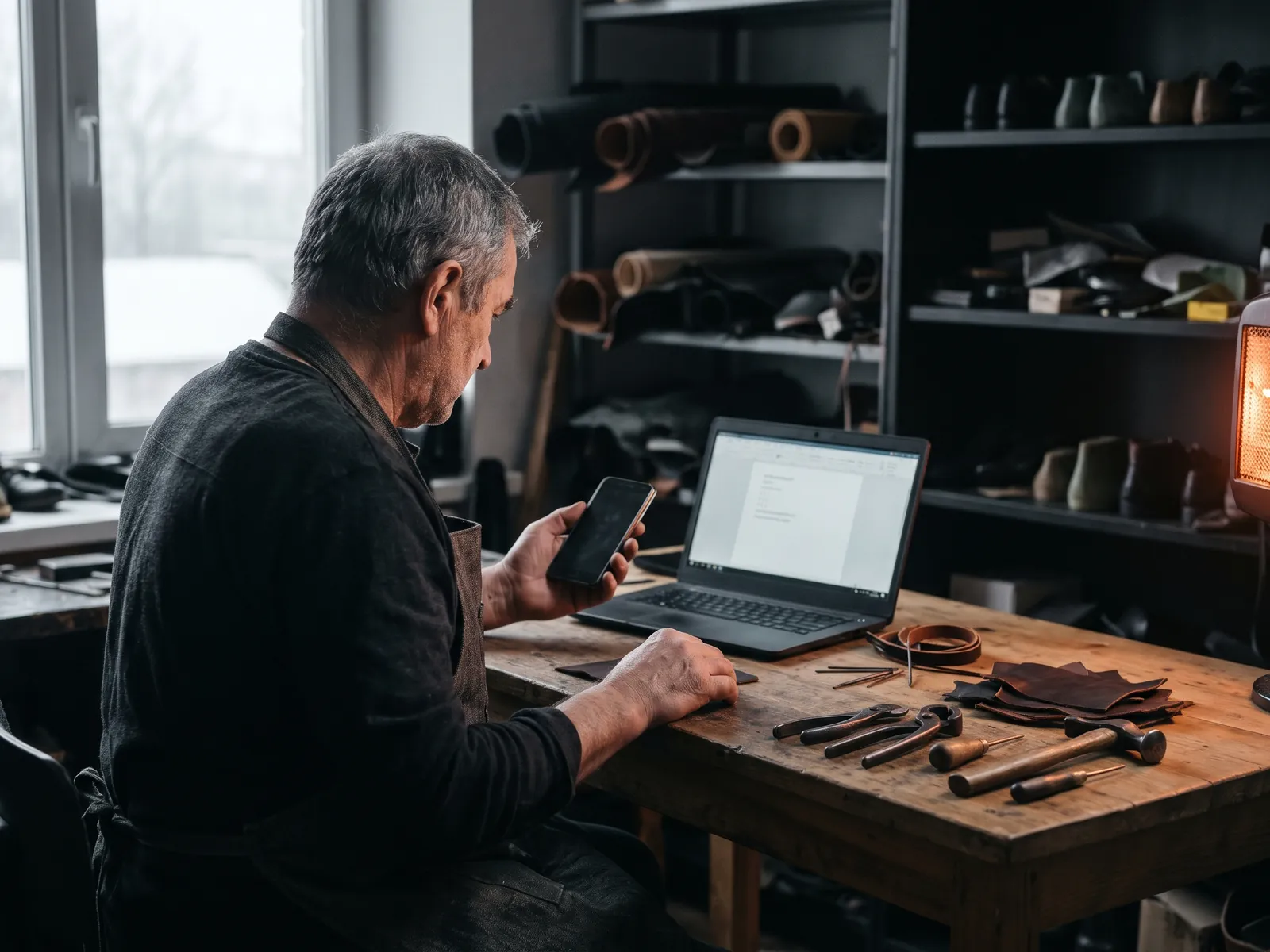
A brochure website suits small businesses that mostly need to be findable and credible rather than to sell online. A shoe repairer in Shrewsbury, a mobile beautician covering Swansea, a gardener in the Cotswolds, a sole-trader bookkeeper: their customers often hear about them from a neighbour or see them on Google Maps, then look for a website to check they are genuine. The site answers that check quickly and makes it easy to call.
It is also a sensible first step for a new business. You can launch a small, tidy site in a couple of weeks and add more once you know which services people ask about most.
What makes a small site work
Small sites fail for the same reasons big ones do, just faster. The usual mistakes:
- A vague headline. "Quality you can trust" tells nobody anything. "Shoe and bag repairs in Shrewsbury town centre" does.
- No prices. Many owners worry about scaring people off. In practice, a price range filters out bargain hunters and gives serious customers the confidence to call.
- Hidden contact details. On a phone, the call button should be visible all the time, not hidden in the footer.
- Stock photos. A real photo of your workbench or van does more for trust than a polished image of strangers.
- Missing basics. A privacy notice if you have a form, and a cookie banner if you use advertising or most analytics tools, as PECR requires.
The article on what every small business website needs has a fuller checklist.
One page or a few?
A one-page brochure site puts everything on a single scrolling page: introduction, services, prices, photos, reviews, contact. It is quick to read on a phone and costs from £400. It works well for one main service in one area.
A multi-page brochure site, from £850, gives each main service its own page, plus pages for prices and contact. That helps when customers search for different things, for example "wedding hair" and "bridal makeup", because each page can rank for its own search. If you go further, with many services and areas, you are looking at a full business website.
Built properly, even when small
Even a small site is built hand-coded, without a page builder. That means no monthly platform fee, no plugin updates, and a page that opens quickly on rural mobile signal. You own the domain, the hosting account and the code. If you are not sure what those words mean in practice, read domains and hosting basics before you buy anything.
I write the copy for you after a short call, so you are not left staring at a blank page. You only correct facts and approve. Simple editable areas let you change opening hours or prices yourself; anything bigger is a quick message to me.
Pair it with Google Maps
For most local businesses, the Google Business Profile brings as many calls as the website. I link the two at launch: your profile points to the site, and the site shows your area and reviews. Add Apple Business Connect and Bing Places as well, which take an afternoon and are often forgotten. If your work comes mainly from a few directories such as Checkatrade or Yell, the site gives those visitors somewhere to confirm you are a proper business.
What it costs to run afterwards
Once the site is live, the running costs are hosting and the domain renewal, both agreed individually and paid in your name. There is no builder subscription. Support after launch and a short training call are included. If you later want small changes, such as a new photo, a Christmas opening notice or an updated price list, you can send them over WhatsApp or email.
When you are ready, book a free 30-minute call or send a short brief. I reply within one working day.
Next steps
Brochure site
questions
Is a brochure website enough for my business?
For many sole traders and small local firms, yes, especially if most work comes from recommendations and Google Maps. It gives people somewhere to check you are real before they ring. If you plan to advertise several services, or rely on Google search for new customers, a business website with separate service pages will usually earn more.
One page or several pages?
One page suits a single service in one area, for example a mobile car valeter. Several pages make sense when you offer distinct services that people search for separately, or when you want to show prices and galleries in more depth. I will recommend one or the other on the call, based on how your customers search.
Can I add pages later?
Yes. The site is built so that new pages can be added without starting again. Many owners start with a one-page site, see which questions customers keep asking, then add a page for each main service a few months later. Adding pages later is priced at the time, before any work starts.
Do I still need a Google Business Profile?
Absolutely. For local businesses the profile often brings more calls than the website itself, because it appears on the map. The two work together: the profile sends people to the site, and the site confirms you are trustworthy. I link them at launch and can help with the profile as part of local SEO.
A clear site
in about two weeks
Send me what you do and where you work. I will reply within one working day with a suggestion and a fixed price.